Public Interest Transportation Forum
An Independent E-zine on Public Transportation
and Mobility Issues in the Puget Sound Region
|
PITF has been on-line since 1996! See it here as in 1996.
For a new direction as PITF entered its third decade of online presentation, and as Sound Transit with voter support advanced its $54 billion ST3 expansion plan, we decided to try describing what's happening with some rhythm in a music video titled "Seattle Train Wreck." Click here http://trainwreck.video to see our efforts in music production.
|
|
Last Update: August 1, 2021
|
|
Hosted by Global Telematics in Seattle
Founders: Dick Nelson (R.I.P.: 1936-2019), John Niles, and Jerry Schneider
Editor in Chief: John Niles
Contributing Authors: James MacIsaac (R.I.P.: 1941-2014), Emory Bundy, Rich Harkness, Don Padelford
Click here to offer a comment, including error reports, on anything you read on this site. 
|
The "paint-is-cheap" speech by Peter Rogoff in 2010 while he was Federal Transit Administrator pertains to his current job.
Former Federal Transit Administrator Peter Rogoff, now the CEO of Sound Transit, made some remarks from a prepared text in 2010 at a transit focused conference in Boston. His thoughtful remarks were widely discussed at the time around the U.S., and are still being discussed by critics of transit development in the central Puget Sound region. Rogoff offered wise policy guidance in 2010 that is still pertinent for transit leaders and transit supporters in the Sound Transit service territory, which is now under pressure to control rising costs of light rail right-of-way acquisition and construction. Rogoff declared in his remarks for the record in 2010:
Supporters of public transit must be willing to share some simple truths that folks don't want to hear. One is this -- Paint is cheap, rails [sic] systems are extremely expensive.
Yes, transit riders often want to go by rail. But it turns out you can entice even diehard rail riders onto a bus, if you call it a "special" bus and just paint it a different color than the rest of the fleet.
Once you've got special buses, it turns out that busways are cheap. Take that paint can and paint a designated bus lane on the street system. Throw in signal preemption, and you can move a lot of people at very little cost compared to rail.
A little honesty about the differences between bus and rail can have some profound effects.
While billions of dollars have been spent on Seattle region's light rail network so far, billions more are planned. What remains for the network expansion is compatible with high quality bus service as well as light rail construction, with vast cost differences.
Seattle Times reporter Mike Lindblom, July 27, 2019: "More than 75 collisions have occurred in the history of the Link light-rail line, which just marked its 10th anniversary. Most have involved vehicles whose drivers turned left against a red signal, but at least 21 have involved people who accidentally or deliberately stepped into the path of a train."
Archive of older stories:
Issues in the first Prop 1 election which Sound Transit lost, not that much different than issues in the second Prop 1 election that Sound Transit won.
Sound Transit releases Final Environmental Impact Statement for the six-mile light rail subway between downtown Seattle and Northgate, the Seattle "Big Dig."
King County Metro posts trip cost calculator focused on gasoline price vs bus fare.
 High Quality Bus Services Attract as Many New Riders as Rail
CETA recommends USDOT analyze monorail and light rail history and results before recertifying Puget Sound Regional Council to continue conducting transportation planning
Planning Tutorial -- USDOT asks questions, Puget Sound Regional Council provides answers on meeting transportation planning requirements.
Let Voters Trust Transportation Planning by Richard Harkness, Dick Paylor, and Bill Popp (extended version of Op-Ed in the September 30, 2005 Seattle Post Intelligencer, with research sources)
Bias and Misrepresentation in Sound Transit Analysis of East King County Transit Options
Sound Transit and its Citizen Oversight Panel by Emory Bundy
Updated Sound Transit Report Card by Emory Bundy, reformatted with graphics in pdf
How Sound Transit Abused the Planning Process to Promote Light Rail by Richard C. Harkness, Ph.D

Click for real-time Puget Sound regional travel times from Washington State DOT
Viewings since 1996:
Introduction
In November 1996 citizens living in the central Puget Sound region of the Pacific Northwest of the U.S. voted to raise their local taxes and begin implementation of a ten year, $3,900,000,000 rail and bus plan to expand public transportation facilities and services. The plan -- after 14 years overrunning both the approved budget and the original schedule -- is administered by a public agency and special government taxing district, the Puget Sound Regional Transit Authority (RTA), later renaming itself Sound Transit. This region includes parts of three counties and the major Washington State cities of Seattle, Tacoma, Bellevue and Everett, with a total regional population of about 3 million.
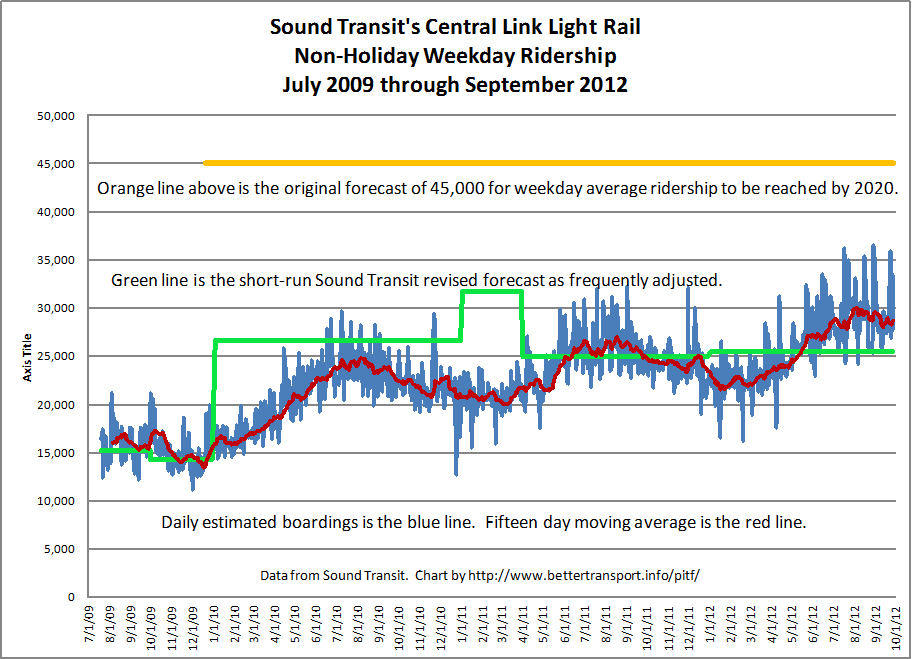
This web site is maintained by a group of Puget Sound area residents who have since 1996 opposed certain parts of the Plan including light rail. We knew back then that voters were deceived about what they were approving, and we said so during the 1996 campaign. In December 2000, Sound Transit revealed that its Seattle light rail plan would cost $1,000,000,000 more than what voters approved, and take three additional years to build. As of late 2012, the first light rail line in Seattle -- opened in July 2009 -- is operating with lower reliability than promised and is well short of the ridership forecast made before opening. Important parts of the 1996 plan were delayed until a phase 2 doubling of the Sound Transit sales tax, a $23 billion phase 2 expansion plan, was approved by voters on November 4, 2008 by a margin of 57% to 43%. This approval came despite false claims made by Sound Transit about cost and performance, as documented within this site.
This Public Interest Transportation Forum presents information that bears on halting light rail expansion and replacing it with other available options that would be implemented faster, cost less, and at the same time achieve better levels of mobility, environmental quality, economic vitality, and general welfare in the region than are currently anticipated in the official Plan. More on why we are doing this.
The Seattle region already has an excellent bus-HOV transit system, organized by county, in which Sound Transit now operates express bus service. To learn more about existing transit systems, click here.
Co-editor John Niles works on bus improvement research with Mineta Transportation Institute and Breakthrough Technologies Institute.
Co-editors Nelson and Niles have conducted university-funded research on transit-oriented development. Check out a series of papers and presentations for the Transportation Research Board.
Table of Contents
HELP US TO TELL OTHERS ABOUT THIS SITE!
Last Modified: January 27, 2019
Jump to Top of Page
Contact the Editors via email: niles@globaltelematics.com
NO PERSONAL INFORMATION IS COLLECTED ON THIS WEBSITE
 Item posted: September 11, 2019
 Very Small Portion of Prop 1 Taxes Go to Relieve Bus Overcrowding
 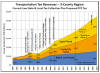 Sound Transit's Prop 1 Victory Sends Taxes Soaring Upward for Little Effect on Regional Mobility
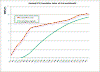 There they go again: Sound Transit falsely claimed in 2008 that benefits exceed costs in light rail expansion, just like the agency claimed in 2007.

