
Will the rails moving ten inches up and down, and five inches from side to side make cross-Lake trains on the I-90 floating bridge possible? Sound Transit staff reported that they have a solution ... what has worked for the SkyTrain bridge just north of Seattle in the suburbs of Vancouver, British Columbia.
The U.S. Government responded in a comment letter on the draft Environmental Impact Statement, "The degree of movement and rotation of the I-90 floating bridge joint substantially exceeds that of a typical suspension bridge. While we agree that this is probably the best comparison to make since there are no floating bridges that have light rail, we do not agree that there has been enough work done to justify the conclusion that this comparison demonstrates that it is feasible to design a light rail track system to accommodate the movements of the I-90 floating bridge. We think there is additional work to be done to determine if it is feasible to design an expansion joint to accommodate light rail."
That additional work is now underway in the Track Bridge System & Prototype Project, Phase 1 Design Services. A document excerpt from that project, Track Bridge System document (1.7 meg pdf), includes a description of I-90 floating bridge movement -- surge, heave, sway, roll, yaw, and pitch -- to be managed in the design for railroad track connections between land and the bridge. As of late March, 2011 the status of this consulting project was reported, "Notice-to-proceed issued and partnering session held with WSDOT in March."
Presentation by Washington State DOT to the Legislature on April 8, 2008
Light Rail Train
Impacts, I-90 Homer Hadley Floating Bridge, Independent Review Team
Final Report, 15 September 2008
For over a decade, Sound Transit in the Seattle area has been planning one of its Link light rail segments to cross the I-90 floating bridge spanning Lake Washington between Seattle and Mercer Island.
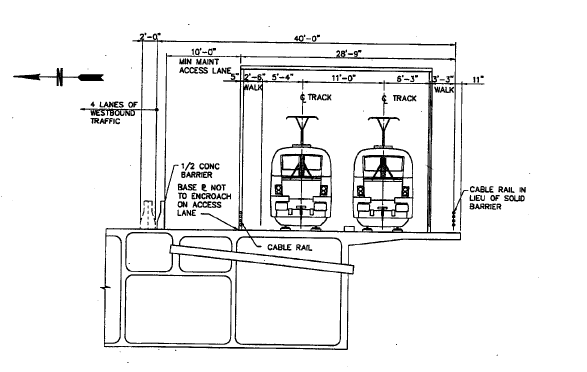
The configuration of the track bed off center on the northernmost of the two parallel floating bridge segments is shown in the figure above. This alignment takes over what is called the Center Roadway, now dedicated to reversible HOV lanes. A technical report from KPFF Consulting Engineers in November 2005 provides evidence that the off-center placement of tracks on one of the bridge segments as shown won't sink the bridge or otherwise hurt it.
Reduced weight in the track design is important, so engineers have specified "continuous welded rail (CWR) with direct fixation track on doweled concrete single fastener plinth with restraining rail to reduce the dead load on the bridge."
A key question is whether light rail trains can successfully operate on a bridge that moves. The report calculates the movement of the track bed that results at the point where the floating bridge is attached to the Lake Washington shoreline in Seattle (excerpt from the report here).
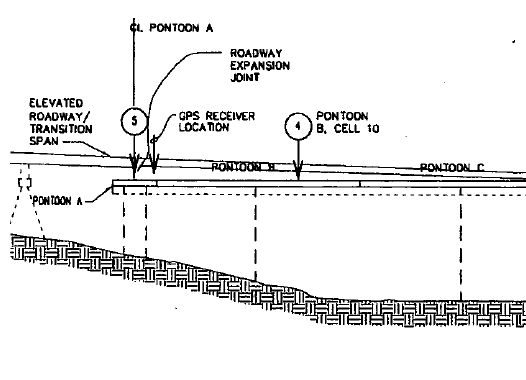
That movement described in the KPFF technical report indicates the magnitude of the design challenge that this plan represents -- vertical rail movement (up and down) of ten inches, and horizontal rail movement (side to side) of five inches. This movement occurs at a roadway expansion joint on the transition segment between the part of the bridge that is floating, and the part that is attached to the Seattle shoreline, shown in the following figure from the technical report.
The movement occurs because of the weight of the moving trains, trucks, cars, and buses on the bridge, plus the effect of wind. This much movement would occur on a very stormy day, the kind that occurs about once per year. On a calm day, the amount of movement would be about an inch less on each of the two dimensions.
The report clearly puts the decision on whether this much movement is possible with light rail passenger trains with "Sound Transit's rail designers."
An excerpt from the KPFF Report is available for download here in pdf (1 megabyte).
A determination on an acceptable solution for moving tracks was reported by Sound Transit staff at the agency's Board of Directors meeting of April 27, 2006. In summary, consultants to Sound Transit assess that a design of tracks on springs successfully engineered for the cable-stayed bridge crossing for SkyTrain rail transit over the Fraser River in New Westminster, British Columbia, Canada will suffice to cover all of the predicted motion described by KPFF. An excerpt with illustrations from the report to the Sound Transit Board is here in pdf.
In a letter dated July 23, 2008, Sound Transit's Chief Executive Officer assured the State Secretary of Transportation that "Sound Transit has responsibility for the cost and risk to construct and maintain electric light rail on the I-90 bridge."
As of April 2014, Parsons Brinckerhoff reports that a design for the light rail track bridge between the fixed and floating portions of the I-90 bridge has been designed, built, and tested. This report from PB does not cover all of the points about reliability and maintenance recommended by an earlier independent review team.
Aside from the issue of technical feasibility, another question about light rail on the I-90 floating bridge is the reduction in vehicle, freight, and passenger capacity that this use of right-of-way represents. This issue is described here.
Return to the Public Interest Transportation Forum home page.
Last modified: May 04, 2014